Brainspotting Therapy in Seattle
For what you can talk about all day without ever quite touching.
Practice details
You have the words. The words aren't getting at it.
Talk therapy was built for one kind of being stuck: not having words for what happened. But there is another kind of stuck. You have all the words. You can describe the pattern. You can trace its history. You can tell the story so well it almost sounds finished. The telling doesn't touch it.
That's not a failure of insight. It's a limit of where insight can go. What keeps you stuck was never stored as a story in the first place. It lives in your body. The grief stays lodged under your sternum while you explain it clearly. The dread arrives on schedule whether or not you understand where it comes from. Some of it settled in before you had words at all. Talking can't always reach that far back.
Brainspotting was built for this. It works underneath the story, where the thing actually lives.
How Brainspotting works
Brainspotting was developed in 2003 by David Grand, a psychoanalyst and EMDR clinician who noticed mid-session that when a client's gaze rested at one precise point, processing deepened on its own. Grand's shorthand: "Where you look affects how you feel."
In practice it's simple to describe. You hold whatever brings you in, lightly. A feeling, a body sensation, a situation, with or without a memory attached. We find the eye position where the activation is strongest, or where your system feels most steady. That point is the brainspot. You rest your eyes there, often with quiet bilateral sound in headphones. Your attention stays on the felt sense: your body's sense of the whole situation, there before you have words for it. Your system does the processing. My job is to stay precisely with you while it does. There's no protocol marching you through steps. Often there's not much talking at all. Most people are surprised by how much moves in the quiet.
Brainspotting is a young method. EMDR stood in the same place twenty years ago: a small but growing evidence base, a mechanism still being worked out, and clinicians who kept using it because of what it did in the room. Brainspotting is there now. Early studies show promising results, including in comparisons with established trauma treatments. I'm certified in both. Which one we reach for depends on what your system needs, not on which decade the research started.
The account of change underneath both methods is the same: reactivated learning, met by an experience that contradicts it. The full account, with sources: How Therapy Changes Memory.
I'm Certified in Brainspotting — a credential beyond the introductory trainings, reached through advanced training, documented client work, and consultation with a certified Brainspotting consultant. See full credentials →
Brainspotting and EMDR: why I offer both
I'm Certified in Brainspotting and an EMDRIA Certified EMDR therapist, so the choice between them is never about which one I happen to know. It's about which door your system will open.
EMDR is structured. It works from a target memory through an eight-phase protocol, and its research base is deep. When there's a defined memory carrying the charge, EMDR is often the straightest line. Read about EMDR in my practice →
Brainspotting is open. It doesn't need a target memory, a narrative, or much language. It tolerates not-knowing. It follows activation instead of directing it, which makes room for what never had a story: experience from your earliest years, dread that lives in the body, the thing you can only point toward.
In the room, that difference matters most when:
- There's no clear memory to target. You feel the weight, but it doesn't attach to an event EMDR could work from.
- Words are your best defense. High-insight, high-verbal people can narrate their way around anything, including their own healing. Brainspotting works underneath the narration.
- EMDR plateaus. Processing that stalls or loops sometimes frees up when we switch to a spot and let the system lead.
- The material is early. It comes from the years before you could say what was happening.
- You're shut down rather than flooded. Brainspotting can work gently with numbness and collapse, at whatever distance your system needs.
They also work in sequence. Some clients stabilize in Brainspotting and then finish targets with EMDR; others use Brainspotting to reach what EMDR located but couldn't move.
What a session is like
We start by settling on what to work with, named as precisely or as vaguely as you can manage. The conversation with your father. The dread on Sunday nights. The thing in your chest that doesn't have a name yet.
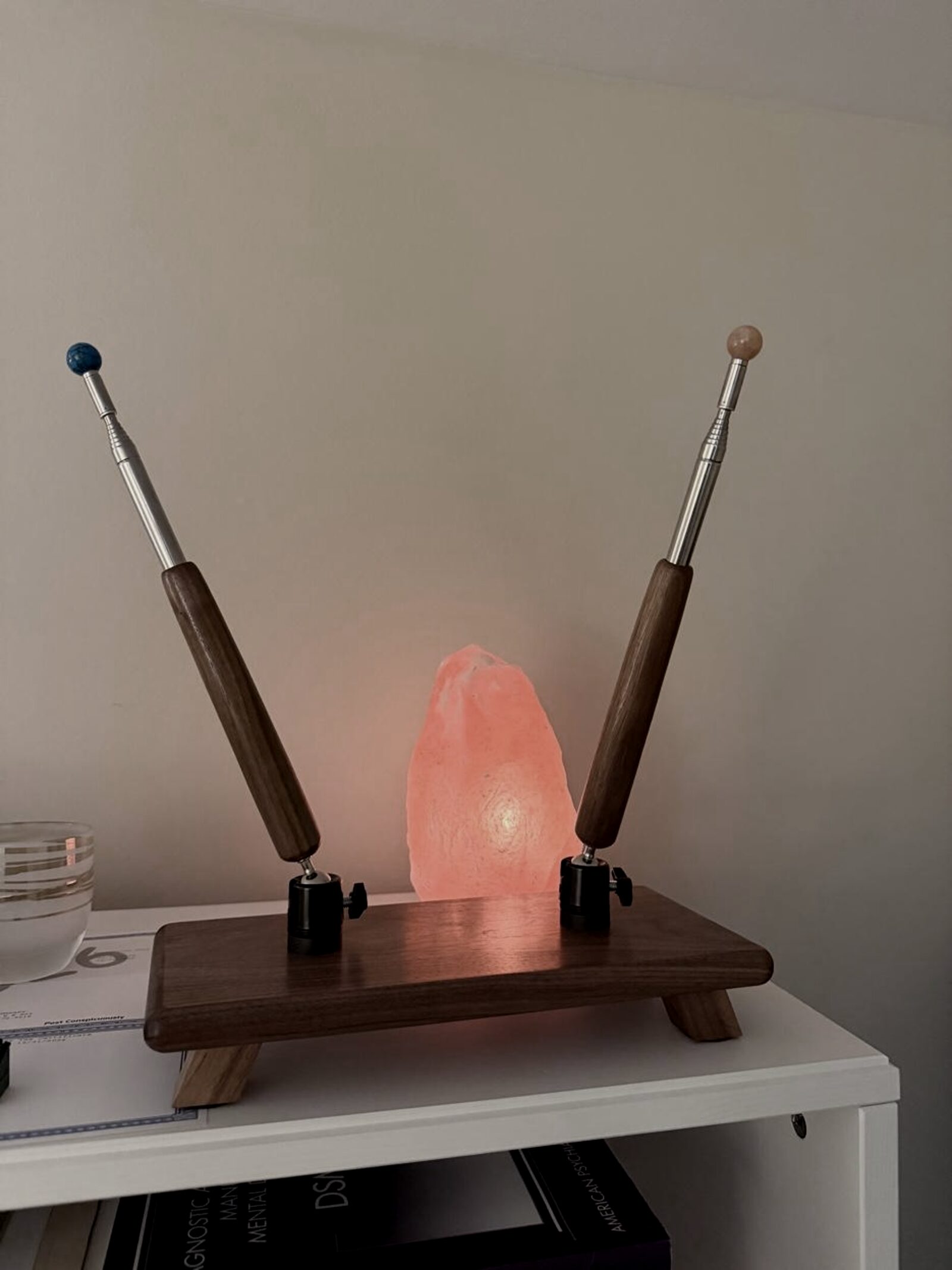
Then we find the spot. I move a pointer slowly across your field of vision while you track it, and we watch for where the activation sharpens: a breath change, an eye flicker, a swallow, something you feel before you could explain it. You don't have to figure anything out.
Then, mostly, quiet. Your gaze rests on the spot. Your attention stays with the felt sense — the weight or heat or movement of whatever is actually there. You're not analyzing it or narrating it. You're staying aware while your system does what it couldn't do on its own. Images may come, or memories, or waves of feeling. Sometimes there are long stretches of stillness that are quietly doing something. I'm tracking you the whole way — attuned to you and to what your nervous system is doing. If the work gets intense, we adjust the distance. You're never left alone in it.
Sessions run 55 minutes; when a piece of work needs more room, we may schedule a 90-minute session, prorated from the standard session rate. Afterward, people often describe feeling wrung out but lighter. The processing tends to keep moving quietly for days.
What Brainspotting can help with
Trauma without a clean narrative — Complex and developmental trauma, early experience stored before language, the aftermath of chaotic years that never sorted themselves into separate events. More on how I work with trauma →
What talk therapy couldn't finish — Years of good insight that stopped short of the body. You understand it; it still runs you.
Anxiety and dread that live in the body — The chest weight, the stomach drop, the bracing that arrives before thought.
Grief — Including grief that's tangled with guilt or unfinished business, where the feeling sits deeper than the words for it.
Shutdown and numbness — When the problem isn't too much feeling but the absence of it, Brainspotting can work at the edge of what's reachable without forcing anything.
Performance and creative blocks — Brainspotting grew up partly in performance work and is widely used with athletes, performers, and writers: the freeze, the yips, the block often trace to something the body is guarding.
Not only for what hurts
The same attention that finds where your body holds an old wound can find where it holds steadiness, confidence, or aliveness.
Brainspotting calls this expansion work. Instead of starting from what's wrong, we start from a state you want more of. The groundedness of a good morning. The focus that arrives when you're playing music. The version of you that speaks without rehearsing first. Your body holds these too, and they have spots. We find one. You rest your attention there. The state gets roomier, more available, easier to find again when you need it.
For athletes, performers, and creatives, this is often the whole point. In trauma work it matters differently. Expansion builds ground to stand on while the harder processing happens.
How I hold it
The pointer isn't the therapy. The attunement is. Brainspotting is a relational somatic approach: the processing happens in your body, and it happens because someone is with you while it does.
Brainspotting in my practice sits inside the same existential-phenomenological orientation as everything else I do. That's a heavy phrase for a plain discipline: attend to what's actually there before deciding what it means. The felt sense is where that discipline becomes physical. You stay with it. You let it show you what it is. I hold myself to the same instruction from my chair — I attend to what shows up in you, not to the category I had ready. The spot gives your system a doorway. The relationship makes it safe to walk through. When something surfaces that wants meaning made of it, we make meaning. That isn't a detour from the processing. It's what the processing is for.
And because no single method fits every nervous system, Brainspotting here is held alongside EMDR, Flash Technique, and, where clinically appropriate with medical oversight, Ketamine-Assisted Psychotherapy (KAP). We use what your system responds to, and we say so honestly when it's time to switch tools.
Is Brainspotting right for you?
Brainspotting might be a good fit if:
- You've done real talk therapy and can narrate your history fluently, and the feelings haven't moved
- What troubles you doesn't attach to a clear memory, or comes from very early in your life
- You'd rather not tell the details, or there are no details, only a felt sense
- EMDR helped and then stalled, or felt like the wrong shape for how you process
- You experience more numbness and shutdown than overwhelm, and need something that works gently
- A performance or creative block keeps its grip despite every mindset fix you've tried
Brainspotting might not be the best fit if:
- You're in acute crisis or don't yet have basic day-to-day stability
- You want a highly structured, session-by-session protocol; EMDR may suit you better
- You're actively using substances in ways that would interfere with processing
If you're not sure, that's a normal place to start. Fit is something we'd figure out together. If Brainspotting isn't the right tool, EMDR, Flash Technique, or relational depth work may be. Learn more about my approach →
Credentials
- Certified in Brainspotting — Brainspotting Trainings LLC; listed in the official Brainspotting directory and with the Rocky Mountain Brainspotting Institute
- EMDRIA Certified EMDR Therapist — Advanced certification from the EMDR International Association
- Licensed Mental Health Counselor (LMHC), Washington State
- Flash Technique | Ketamine-Assisted Psychotherapy (KAP)
- Teaching Faculty, Seattle University Psychology Department
Common Questions
Is Brainspotting evidence-based?
Brainspotting is roughly where EMDR stood twenty years ago: a small but growing evidence base. Early outcome studies, including comparisons with established trauma treatments, show promising results while the mechanism is still being worked out, and clinicians keep using it because of what it does in the room, which is also how EMDR's evidence base got built. I hold certifications in both. EMDR brings the deeper research record. Brainspotting can reach material EMDR sometimes can't. We use whichever your system responds to.
What's the difference between Brainspotting and EMDR?
Both are brain-body therapies that use the visual field to process stored experience, and Brainspotting grew out of EMDR work. EMDR is structured: a defined target memory, an eight-phase protocol, sets of bilateral stimulation. Brainspotting is open: a fixed gaze position, minimal protocol, the client's system leading. EMDR tends to shine with clear memories; Brainspotting with material that has no clean narrative: early experience, body-level dread, shutdown. Many of my clients use both at different points.
Do I have to talk about what happened?
No, and even less than in EMDR. Brainspotting doesn't need a narrative at all. You can work an entire session from "this heaviness in my chest" without ever naming its history aloud. Your system does the processing. My role is to stay attuned and keep the work at a distance you can handle, not to collect details.
What is a brainspot?
A brainspot is an eye position that correlates with activation in your body: a point in your visual field where, when your gaze rests there, the material you're holding becomes more accessible. We find it by slowly tracking a pointer while noticing where your body responds. A breath change, a flicker, a swell of feeling. As for the science, the correlation is observable in the room; the neurological explanation for why remains a working hypothesis.
What does a Brainspotting session feel like?
Quieter than you'd expect. After we find the spot, most of the session is you gazing there, mindfully tracking the felt sense in your body while things move: images, memories, emotion arriving in waves, sometimes long stretches of stillness that are quietly working. People often describe it as the feeling of something finally draining, or of watching their own mind work from one step back. Afterward you may be tired, and often lighter. Processing usually continues gently for a few days.
How many sessions will I need?
It varies more than a clean answer would suggest. A discrete recent stressor or a performance block can shift in a handful of sessions. Complex and developmental trauma is slower work, measured in months rather than weeks, because we're processing layers rather than an event. What I can promise is the honest check-in as we go: whether things are moving, and whether Brainspotting is still the right tool or it's time to bring in EMDR or another approach.
Is Brainspotting covered by insurance in Seattle?
Yes. Brainspotting is billed as standard psychotherapy and is covered by most insurance plans. I am in-network with several major carriers — the current list is on the rates page. For out-of-network plans I provide superbills, and I work with Thrizer to simplify out-of-network billing.
Does Brainspotting work over telehealth?
Yes. Brainspotting adapts to video well. We find spots using your own gaze positions on and around the screen, or with your hand as a pointer under my guidance, and the attunement side of the work translates surprisingly intact. I offer it in person in Capitol Hill and by telehealth across Washington State and Colorado. Some clients prefer their first session or two in person and continue remotely; either order works.
Is Brainspotting only for trauma?
No. Trauma processing is the best-known use, and it's most of my practice. But Brainspotting also does expansion work: finding and growing the states you want more access to, like steadiness, focus, or creative flow. Athletes and performers use it this way routinely. In therapy the two directions feed each other. Clearing what's stuck makes room. Expansion helps you live in it.
Is Brainspotting hypnosis?
No. You're not in a trance, you're not suggestible, and nothing is being implanted or retrieved by me. You stay fully present and in control the entire time; you can talk, pause, or stop whenever you choose. The state is closer to focused mindfulness than to anything altered: awake, aware, attention resting on the felt sense in your body. What's doing the work is your own nervous system, with the gaze position holding it in range.
Can Brainspotting be combined with EMDR or KAP?
Yes, and in my practice it often is. Some clients alternate: Brainspotting to reach and loosen material, EMDR to finish defined targets. And for clients working with Ketamine-Assisted Psychotherapy, Brainspotting's low-verbal, body-led style pairs naturally with the medicine sessions and their integration. Because I hold certification in both EMDR and Brainspotting, we can move between them inside one coherent treatment instead of referring out mid-stream.
How I think about this work → Approach
I'm not taking new clients right now. If you're searching, the availability page lists good places to start →