WHAT THIS WORK FEELS LIKE
We slow down. Way down.
There's space for the thing you can't name yet. For the moment when your voice changes and neither of us pretends it didn't happen. For the silence that isn't empty. You don't have to arrive with insight. You don't have to be articulate about your pain. We find it together—in your body, in the moment, in the space between us.
This isn't therapy that stays in your head. We track what's happening in your body as you're talking—the shift in your breathing, the way your eyes go distant, the moment your voice flattens, the impulse to change the subject right when something important surfaces. Those aren't distractions from therapy. They're the therapy. That's where trauma lives, and that's where it heals.
A NOTE ON "DEPTH" AND THE UNCONSCIOUS
I'm sometimes asked how this differs from psychoanalysis.
While I respect psychoanalytic traditions, I don't locate most human experience in a hidden unconscious requiring years of interpretation.
What feels "unconscious" is usually pre-reflective—already alive in your body, emotions, and relational patterns right now. We bring gentle attention to what's showing itself in the present moment. When paired with nervous-system tools (EMDR, Brainspotting, somatic pacing), stuck material can soften surprisingly quickly—often in months rather than years.
This feels less mysterious, less intellectual, and more immediately relieving for adults who've already spent years "understanding" their past without much bodily or emotional shift.
WHO I AM
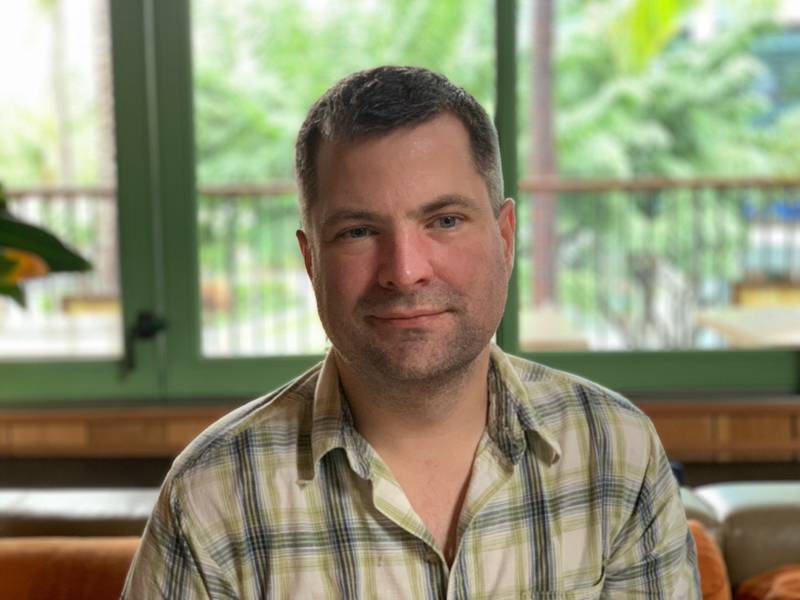
I'm a gay therapist practicing in Seattle, specializing in trauma, EMDR, Brainspotting, and ketamine-assisted psychotherapy. I work with adults—especially men and LGBTQ+ individuals—who want more than symptom management. People who sense their healing requires attention to both their inner world and the larger patterns that shape it.
My work centers on how trauma, shame, and disconnection shape your relationship to yourself and others—and how awareness, embodiment, and meaning-making create pathways toward healing.
That gay-therapist part shapes my work in ways both obvious and subtle: how I understand shame, embodiment, the particular weight of performing normalcy, the long aftermath of living edited. It also means I've done my own excavation around identity, desire, and belonging. For queer clients especially, this matters. But it informs how I sit with anyone whose sense of self has required negotiation.
Therapy with me isn't about "fixing" what's broken. It's about reconnecting with what's already alive within you.
HOW I CAME TO THIS WORK
My path into therapy reflects the integration I now bring to clinical practice.
I began at Reed College studying English literature and film — my senior thesis was on aesthetics, queer identity, and self-construction in Todd Haynes' Velvet Goldmine. I was already circling the questions that would become central to my clinical work: how identity forms under pressure, how performance and authenticity coexist, how people survive by becoming someone the world will accept.
After Reed, I earned an MLIS at the University of Washington and spent over a decade in information architecture and scholarly publishing at ProQuest, in roles that grew from metadata librarian to senior project manager. I designed systems to help researchers navigate overwhelming amounts of complex information: organizing chaos into something navigable and meaningful, finding patterns in fragmentation, holding both granular detail and systemic context.
I didn't know it then, but those years were preparation for trauma therapy. The skill set transfers almost exactly: tracking multiple layers of complexity simultaneously, recognizing structural patterns that aren't visible at the surface, and helping people translate overwhelm into coherence. The information architect became a therapist. The thesis on identity and performance became a clinical practice built on authenticity.
Before entering my graduate program in psychology, I completed a BS in Psychology at Washington State University, graduating summa cum laude. That formal grounding in psychological science — research methods, neuroscience, developmental and abnormal psychology — gave me the empirical foundation that now sits underneath my phenomenological orientation.
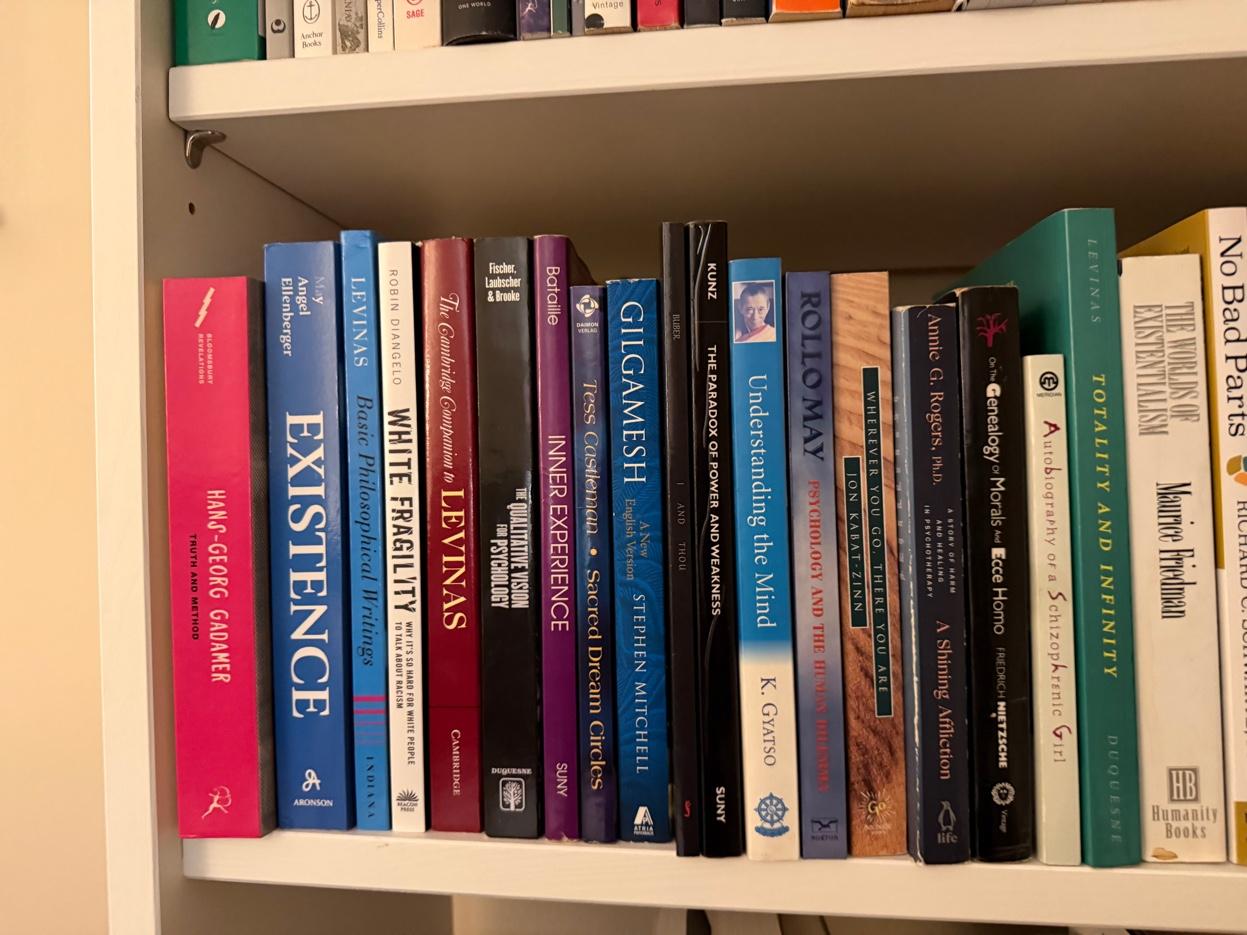
When I returned to graduate school for my MA in Existential-Phenomenological Psychology at Seattle University, everything converged. Phenomenology gave me a language for the interior world — the textures of moments, emotions, and embodied experience.
During and after graduate school, I provided care at community agencies like Valley Cities Behavioral Health and Crisis Connections — working with adults facing severe mental illness, complex trauma, addiction, housing instability, and systemic barriers. That grounding in community mental health keeps my private practice honest.
I also teach courses in research writing, counseling theory, and crisis intervention at Seattle University, where I bring these same integrative principles to training the next generation of clinicians.
Clients describe our work as:
- Grounding
- Emotionally safe
- Clear
- Slow enough to stay regulated
- Deep enough to create real change
- Validating without coddling
- Challenging without pushing
- Steady
- Human
"An obstacle was there that changed the pattern of my actions and the manner of my life"
— Constantine Cavafy, "Hidden Things"
MY PHILOSOPHY
Healing happens where presence and meaning converge.
The goal isn't to erase the past but to complete what it left unfinished—so the past can become past, no longer intruding on the present, and you can live with awareness, agency, and choice.
Good therapy works on multiple levels at once:
- The immediate felt sense of a moment
- The patterns that repeat across moments
- How the body stores trauma
- The meanings you've learned to make
- The relationships that shaped you
- The cultural systems that influence you
Integration isn't about repair—it's about reconnection. Body and mind. Past and present. Self and relationship. Meaning and survival.
My background in information architecture and phenomenology uniquely shapes how I track and integrate these layers. Many clients tell me: "You connect dots I didn't know were connected." That's because I'm tracking the whole of your experience—not just the symptom in front of us.
WHO I WORK WITH
My clients are often thoughtful, intuitive, and intellectually oriented—people who want more than symptom management. People who sense their healing requires attention to both their inner world and the larger patterns that shape it.
I work with:
- Adults navigating trauma, PTSD, or complex grief—whether it happened last year or in childhood
- Men exploring identity, emotional literacy, and authentic connection—from first relationships in their 20s to rebuilding in their 40s and beyond
- Young adults (20s-early 30s) navigating identity, meaning, and life transitions after trauma or family rupture
- LGBTQ+ individuals and couples seeking attuned, embodied, affirming care—at any stage of the coming-out process or identity integration
- People interested in depth work that integrates philosophy, trauma therapy, and neuroscience
- Other therapists and helping professionals doing their own inner work
- Clients pursuing trauma intensives or ketamine-assisted psychotherapy
Many of the people I work with are systems-thinkers themselves—academics, educators, writers, artists, engineers, designers—people who value both emotional attunement and big-picture insight.
MY SPECIALTIES
- Trauma & Complex Trauma — EMDR, Brainspotting, Flash Technique
- EMDR Therapy — EMDRIA Certified for trauma, anxiety, and painful memories
- Men's Mental Health — Anger, shutdown, identity, connection
- LGBTQ+ Affirming Therapy — Shame, identity, minority stress, belonging
- Ketamine-Assisted Psychotherapy — KA-EMDR and traditional KAP
- Psychedelic Integration — Trauma-informed support after journeys
- Trauma Intensives — Half-day and full-day deep work for faster, more concentrated healing
WHY "EPOCHÉ"
In phenomenological philosophy, epoché is the practice of suspending assumptions — setting aside what you think you know so you can see what's actually there.
It's the foundation of how I work. Before diagnosis, before interpretation, before technique — I try to meet you where you are, as you are, without reducing your experience to a category.
The name is a commitment: to presence over presumption.
TRAINING & CREDENTIALS
This philosophy is grounded in ongoing training and clinical development:
Core Credentials:
- Licensed Mental Health Counselor (LMHC), Washington State
- EMDRIA Certified EMDR Therapist
- EMDRIA Consultant in Training (CIT)
- MA, Existential-Phenomenological Psychology, Seattle University
- BS, Psychology, Washington State University, summa cum laude
- MLIS, University of Washington
- BA, English, Reed College
- Teaching Faculty, Seattle University Psychology Department
Trauma Modalities:
- Ketamine Assisted EMDR Therapy: Enhancing Trauma Treatment with Low Dose Ketamine
- Brainspotting Phase 1 & 2
- Flash Technique 1 & 2
- Four Blinks
Psychedelic & Consciousness Work:
- Journey Clinical Ketamine-Assisted Psychotherapy Training (didactic, therapeutic protocols, medical foundations, and experiential)
- EMBARK Psychedelic-assisted Therapy for Major Depression
Relational, Somatic & Contextual Approaches:
- Acceptance and Commitment Therapy (ACT) Intensive (PESI, with Steven C. Hayes)
- EFCT Externship (ICEEFT)
- Hakomi Personhood Series
Crisis Intervention:
- ASIST (Applied Suicide Intervention Skills Training)
If you want to know what grounds this work beneath technique, read the Apologia →